


Artificial intelligence is no longer a novelty in education. It’s infrastructure. In just a few years, AI has moved from the periphery of classroom tools to the core of how content is created, delivered, and personalized. But as adoption accelerates, a deeper question has emerged: how can publishers and EdTech providers use AI responsibly, ensuring that speed and scale never come at the expense of trust, quality, or educational integrity?
Recent executive research by PWC shows that nearly 60% of business leaders say Responsible AI directly boosts ROI and efficiency. For educational publishers, this marks a strategic turning point where responsibility is no longer a compliance checkbox but a competitive advantage.
From AI Efficiency to Educational Integrity
The conversation around AI in education has matured. Early enthusiasm for automation: AI-generated questions, quizzes, and summaries, is giving way to more nuanced thinking about transparency, intellectual property, and human oversight. Responsible implementation means designing systems that empower educators rather than replace them, and that protect the content ecosystems publishers have built for decades.
Today’s most forward-looking solutions embed these values into their architecture. Platforms such as EdTool and EdTool PRO, for instance, have adopted ethical AI principles by design: no use of uploaded materials for training, no user profiling, and full GDPR compliance. Rather than treating data ethics as an afterthought, they turn it into a foundation for innovation.
This shift reflects a broader truth in EdTech: trust is the new currency of digital education.

Building Connected and Transparent Ecosystems
In 2025, the real competitive opportunity for publishers lies in connecting what has long been fragmented: content creation, repository management, and classroom delivery. Until now, these areas have existed in isolation: editorial teams focused on production, distribution happened through intermediaries, and classroom use was rarely visible to content owners.
Emerging AI-driven ecosystems finally make it possible to unify these processes. By linking authoring, distribution, and classroom interaction within one responsible framework, publishers can gain something they’ve never had before – direct visibility into how their content performs in real learning environments, without losing control over data or intellectual property.
A responsible ecosystem means transparency at every layer: where content comes from, how it’s used, and who benefits from it. When AI supports these workflows ethically, publishers retain full control over their intellectual property, while teachers gain flexible, adaptive resources tailored to real classroom needs.
This model turns technology into a partnership. It aligns publishers’ commercial objectives: speed, scale, and revenue diversification, with education’s core mission: accessibility, quality, and equity.
Localization and Accessibility as Growth Strategies
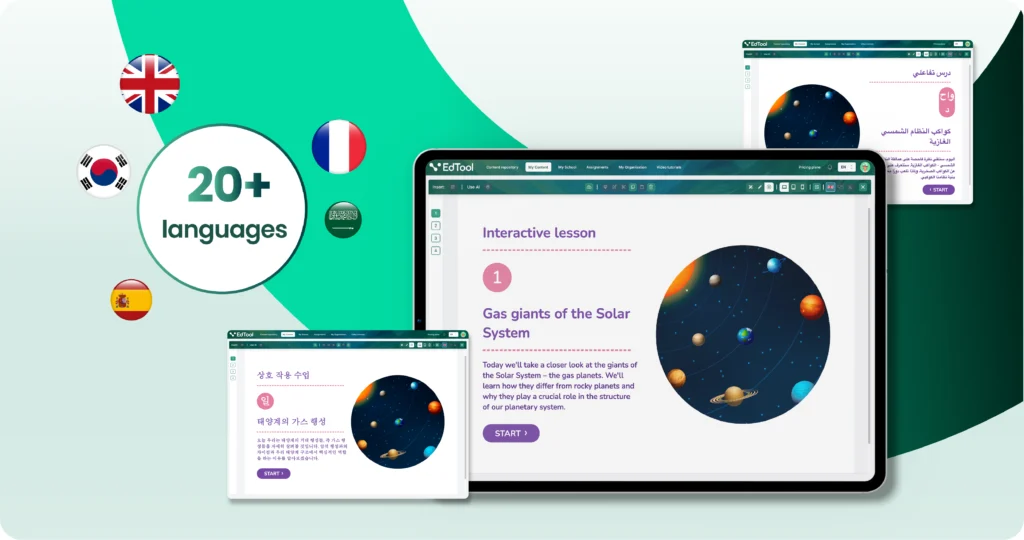
One of the most tangible outcomes of responsible AI is inclusion. Modern educational platforms can translate and adapt materials into 20 or more languages, including right-to-left scripts, directly within their production workflow. The result is not only faster publishing cycles, but also genuine accessibility, reinforced by WCAG-compliant templates and responsive design that work across devices and contexts.
In this light, inclusion becomes a business enabler: the ability to reach new markets, comply with national accessibility mandates, and strengthen a publisher’s reputation as a responsible global partner.
Turning Responsibility into a Strategic Advantage
Ethical use of AI is often discussed as a moral imperative. Increasingly, though, it’s also an operational necessity. As McKinsey’s recent analysis notes, schools and education systems are entering an era of tighter budgets and growing expectations: a combination that demands tools capable of delivering measurable learning impact and efficiency.
For publishers and EdTech providers, this means that responsible, data-transparent AI isn’t just the ethical path – it’s the sustainable one. Solutions that combine adaptability, governance, and accountability will define how education evolves under new financial and regulatory pressures. The leaders of this shift will be those who see responsibility not as a restraint, but as a strategy.
Companies like Learnetic, through platforms such as EdTool and EdTool PRO, are demonstrating how this balance works in practice, integrating AI assistance, accessibility, and content security into publishing and classroom ecosystems that serve both teachers and learners. The message to the industry is clear: progress and ethics can, and must, advance together.
The Future of Educational Publishing: Built on Trust
Responsible AI marks the beginning of a new competitive paradigm in educational publishing. Beyond efficiency, it demands intentional design: technology that amplifies human creativity, protects intellectual property, and keeps learners at the center.
For publishers and EdTech companies, the opportunity lies not in replacing human expertise, but in reinforcing it through intelligent, ethical, and transparent innovation. The next generation of educational technology will not just be smart. It will be responsible, and that’s where leadership will truly begin. The winners will be those who combine innovation with integrity, speed with sustainability, and automation with purpose.
EdTool PRO stands as an example of how that balance can be achieved: a single, AI-powered ePublishing Hub that enables publishers to create, distribute, and deliver interactive, accessible content under their own brand, responsibly, securely, and at scale.
Ready to explore how responsible innovation can reshape your digital publishing strategy? Discover EdTool PRO – the platform built to grow your content, your brand, and your impact.

Fill the form and schedule your EdTool PRO Discovery Call
Explore our AI-powered platform for educational publishers, and get to know how to accelerate content creation, streamline collaboration, and scale your digital publishing operations.
