



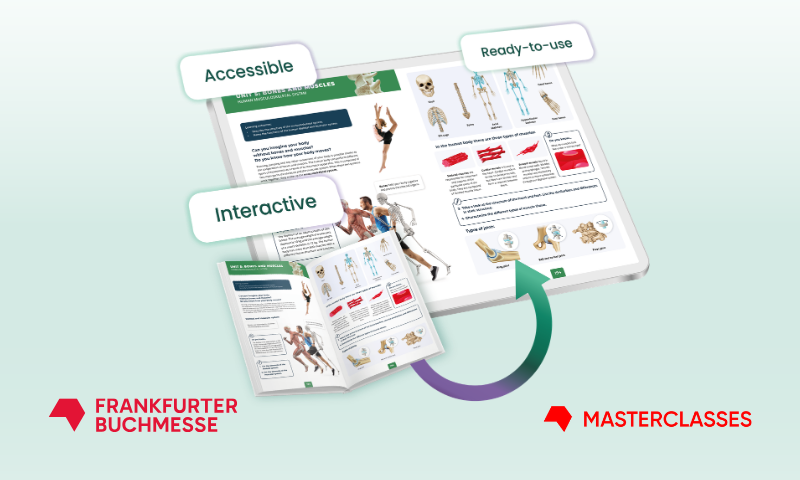
For many educational publishers, digital products still begin where print production ends.
The textbook goes through writing, editing, approval, design, and production. Once the final PDF is ready, another process begins: turning those pages into interactive content, adding multimedia and activities, and preparing everything for digital delivery.
There is nothing inherently wrong with this Print to Digital model. It has worked for educational publishers for years and continues to make sense for many businesses.
But digital is playing a much bigger role in educational products today. So it is worth asking:
Should digital always have to wait for print?
This is one of the questions we will explore during our upcoming online masterclass, Why Your Digital Product Is Usually a Year Behind Print: Integrating AI-supported Print and Digital Workflows for Modern Educational Publishers, together with the growing role of AI in educational publishing workflows.
Why digital is still usually behind print
In a traditional Print to Digital workflow, the logic is straightforward: publishers finish the textbook first and then create the digital product, often using the final PDF as the starting point.
There are good reasons why this model is still widely used. It fits established editorial processes, does not require major organizational changes, and works particularly well when print remains the core commercial product.
It is also familiar to teachers. The digital version can follow the textbook they already know while adding interactive exercises, assessments, and other resources that extend the learning experience.
The main limitation becomes visible when publishers want print and digital products to reach the market at roughly the same time. When one production process has to wait for the other, digital will naturally arrive later. If deadlines are tight, closing that gap can put more pressure on internal teams or increase reliance on external production.
This is one of the areas where AI can already make a practical difference.
How AI makes Print to Digital faster
Using AI does not have to mean rebuilding the entire publishing workflow. Publishers that want to keep their existing Print to Digital model can use it to reduce some of the repetitive work between the finished textbook and the digital product.
For example, AI can help teams:
- convert PDFs into structured content
- recognize different content and exercise types
- generate interactive versions of existing activities
- create metadata
- support accessibility and quality checks
- adapt approved materials for different digital outputs
The publishing process itself can remain largely unchanged, with print created first and digital following afterwards. What changes is the amount of manual work required to move from one to the other.
For many publishers, this may be exactly what they need. Rather than reorganizing the whole production process, they can focus on removing bottlenecks and making an established workflow faster and more efficient.
Print to Digital vs. Print and Digital
Publishers can also consider a different approach in which print and digital products are developed in parallel rather than treating digital as the next production stage after print.
The key difference is where the process starts.
In a Print to Digital workflow:
Textbook → Digital content
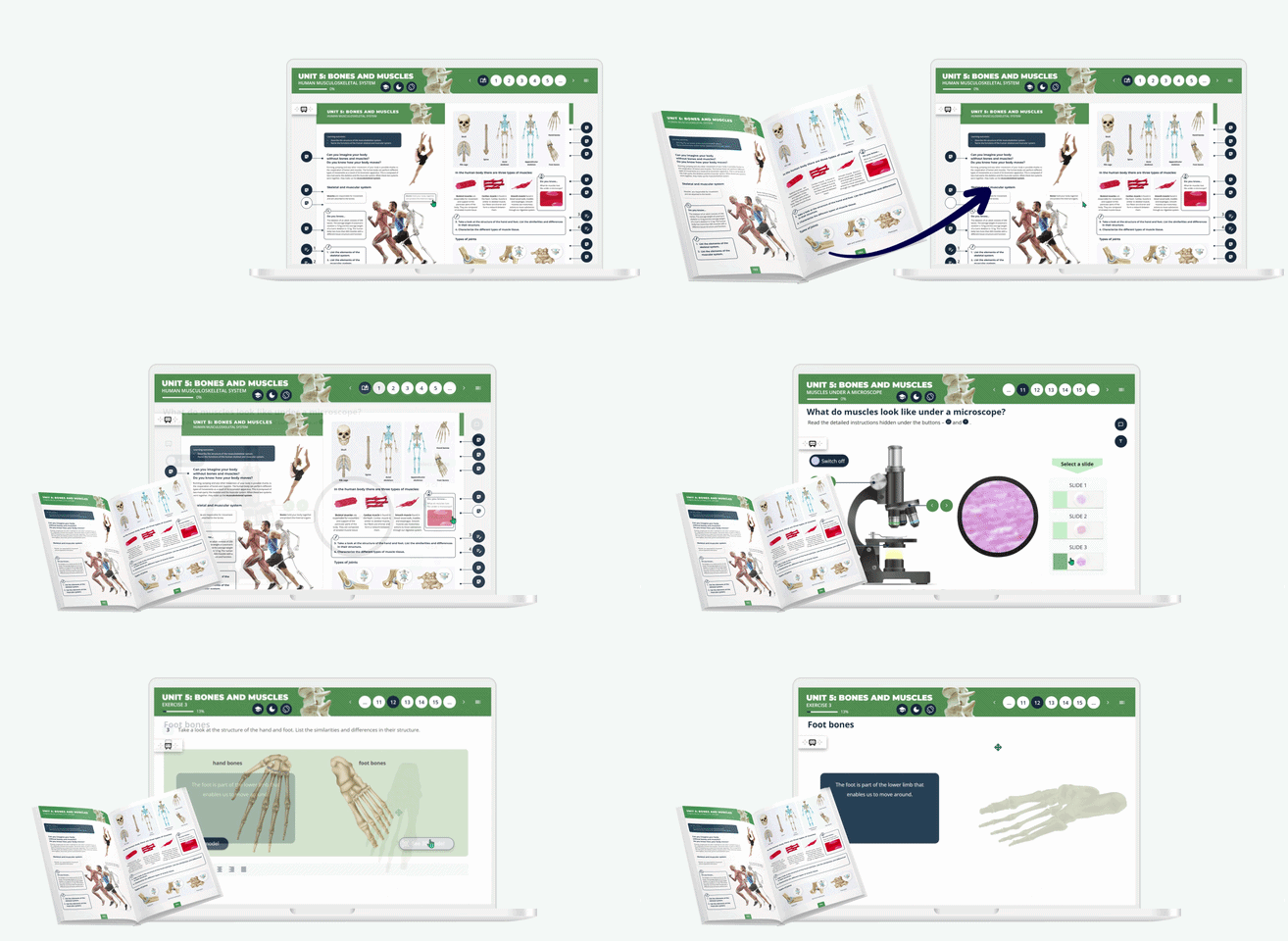
In a parallel Print and Digital workflow:
Shared content bank (Universal Content Objects) → Textbook + Interactive content + Teacher resources + Assessments
Rather than treating the finished textbook page as the primary source, publishers can work with reusable content objects that support multiple outputs.
This approach also creates more freedom in how digital materials are designed because they do not have to reproduce the textbook page by page. A textbook might introduce a concept, while a teacher resource develops it further. An interactive activity can help students explore the same topic from another perspective, while an assessment checks their understanding across these different materials.
In this way, print and digital can become complementary parts of the same teaching methodology rather than one simply being a conversion of the other.
Why AI makes parallel publishing more achievable
Creating print and digital in parallel is not a new idea, but implementing this model has traditionally required structured content, reusable assets, dedicated technology, and much closer coordination between editorial and production teams. For many publishers, the additional complexity and cost have made it difficult to introduce at scale.
AI can reduce some of these barriers by supporting the work needed to build and maintain a shared content structure. It can help publishers classify educational content, identify reusable learning assets, generate metadata and first drafts of activities, adapt materials for different outputs, and keep related resources consistent when content changes.
As a result, some of the repetitive manual work that previously made parallel publishing difficult and expensive can be reduced. This makes the model more accessible without removing the need for a carefully designed editorial process.
For educational publishers, editorial accountability remains essential. Educational content still requires editorial review, pedagogical validation, curriculum alignment, and quality assurance, while subject matter experts and editorial teams remain responsible for what is ultimately published.
AI can therefore support and accelerate editorial work, while decisions about educational quality and publication remain firmly in human hands.
Which publishing workflow fits your strategy?
There is no single publishing workflow that fits every organization.
Print to Digital can remain the right choice when print is the main commercial product, when a publisher has a large existing catalogue to digitize, or when the priority is improving production efficiency without redesigning established editorial processes.
Print and Digital may be more relevant when digital plays a central role in the product strategy, when both formats need to launch together, or when the same educational content needs to support multiple products, languages, or curriculum versions.
The question for publishers is therefore no longer simply: How can we turn print into digital faster?
It is also: How can AI optimize our existing editorial architecture to eliminate the print-to-digital lag?
Join the Online Masterclass
These questions will be at the center of our upcoming online masterclass, where we’ll take a closer look at how AI is changing Print to Digital workflows and opening new possibilities for parallel publishing.
Every year, Frankfurter Buchmesse brings together thousands of publishing professionals to discuss what’s next for our industry. This year, before the fair begins, we’d like to invite you to an online conversation about one of the biggest operational challenges we see across educational publishing.
On 30 September (Wednesday) at 1:00 p.m., Artur Dyro, CEO and Co-founder of Learnetic, will lead the online masterclass:
Why Your Digital Product Is Usually a Year Behind Print
Integrating AI-supported Print and Digital Workflows for Modern Educational Publishers
Drawing on real international publishing projects, Artur will look beyond the technology itself and focus on the workflows behind digital educational products. He will compare two approaches:
- Print to Digital, where a completed textbook or PDF becomes the starting point for digital production
- Print and Digital, where print, interactive content, assessments, and teacher resources are developed in parallel from a shared source of reusable content
The session will also explore where AI can bring practical value across the publishing process: from accelerating PDF conversion and repetitive production tasks to structuring reusable content, supporting legacy content modernization, and keeping multiple publishing outputs consistent.
Whether you’re responsible for editorial strategy, digital publishing, production, or business transformation, you’ll gain practical insights into how AI can support modern educational publishing.
Cannot join the session or prefer to meet in person?
Visit us at Frankfurter Buchmesse, 7–11 October, Hall 4.1, Booth C64.
This article is AI-modified.